Six Formats, and What Each One Commits You To
Bar is a loose word that covers at least six different pieces of cabinetry with very different cost and permit consequences. Picking the right one is most of the decision.
| Format | What it is | What it commits you to |
|---|---|---|
| Dry bar | Cabinetry, counter, bottle and glass storage, no plumbing | No permit for the cabinetry itself. Cheapest route by a wide margin. |
| Wet bar | All of the above plus a sink and drain | Plumbing permit required, plus usually a dedicated circuit. |
| Butler's pantry | A serving run between kitchen and dining, often with storage and a counter | Usually the most useful version in a family house. |
| Wine wall | Racking as a feature, frequently with lighting and sometimes with refrigeration | Capacity is the decision. Most are built larger than they need to be. |
| Coffee station | A counter run with an appliance garage, storage and a circuit | Increasingly the thing people actually use every day. |
| Undercounter refrigeration | A wine or beverage unit built into a base run | Needs a dedicated circuit, front venting and manufacturer clearances. |
The one that gets used most in a family house is the butler's pantry: a serving run on the route between kitchen and dining table. Antelope Valley tract plans frequently have exactly that wall doing nothing, or a decorative niche that converts well. A bar in the far corner of a family room photographs better and gets used at parties.
Wet or Dry: the Decision That Sets Everything Else
A dry bar has cabinetry, a counter and storage, and nothing runs to it except possibly a circuit. It falls squarely inside the California Residential Code Section R105.2 exemption, which lists cabinets and counter tops among work exempt from permit, so it is finish work and proceeds like any other cabinet job.
A wet bar adds a sink and a drain, and that is plumbing work requiring a permit. The cost driver is rarely the fixtures. It is the distance from existing plumbing: a bar backing onto a kitchen or bathroom wall is a modest addition, while a bar in the middle of a family room means running supply and drain a long way through a floor or a wall. Work out that distance before deciding, because it frequently changes the answer.
Bottle and Glass Storage That Works
| Format | What it is for | The dimension that governs |
|---|---|---|
| Horizontal bottle racking | Keeps a cork in contact with wine, which is the reason for the format | About 3.5 to 4 in per bottle in a standard cradle |
| Diamond bins | Stores more bottles per cubic foot than individual cradles | Harder to find a specific bottle. Best for case quantities |
| Upright bottle storage | Fine for spirits, and fine for wine you will drink soon | Takes the height of the bottle plus clearance to lift it out |
| Stemware racks | Glasses hang bowl down, which keeps dust out | Measure your widest bowl. Universal racks are not universal |
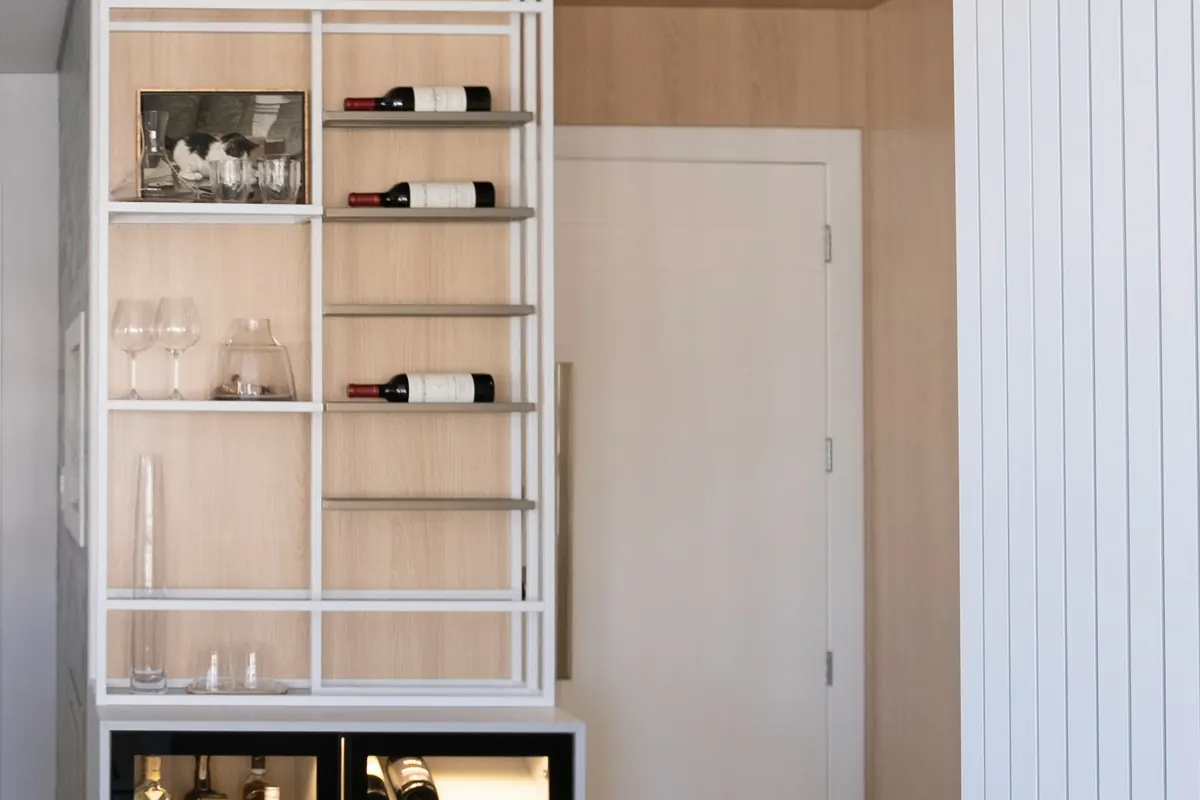
| Glass shelving on rails | Displays bottles label out | Lower capacity per foot than racking, much better to look at |
| Drawer storage for tools | Openers, stoppers, jiggers, pourers | One shallow drawer prevents a permanent counter clutter zone |
Two practical notes. Stemware racks are not universal despite being sold as such: measure the widest bowl you own before anything is built. And one shallow drawer for openers, stoppers and pourers prevents the permanent counter clutter zone that every bar without one develops.
Desert Air and Corks: the Honest Answer
Lancaster is very dry. The NOAA 1991 to 2020 normals at General William J. Fox Airfield record average annual precipitation of 6.81 inches at 2,359 feet elevation. The common worry is whether that dries out corks, and the honest answer has two halves.
The mechanism is real. A cork is a porous natural material, and it behaves the way the USDA Forest Service Wood Handbook describes for wood generally: the moisture remaining in it tends to come to equilibrium with the relative humidity of the surrounding air. Over years, a cork in very dry air can shrink enough to compromise its seal, which is why cellars are humidity controlled and why bottles are stored horizontally so the wine keeps the cork wet from the inside.
The scale is the other half. For a home bar whose bottles turn over in months rather than decades, a room temperature cabinet is entirely fine, and horizontal racking handles the rest. For genuine multi year cellaring, no cabinet solves it: what solves it is a sealed, refrigerated, humidity controlled unit, and a beautiful wine wall in an unconditioned room is a display rather than a cellar. Anyone who tells you otherwise is selling cabinetry. The Wood Handbook chapter that covers the underlying moisture equilibrium is worth a look if you want the physics: USDA Forest Service Wood Handbook, Chapter 13: Drying and Control of Moisture Content and Dimensional Changes.
What an Undercounter Refrigerator Actually Needs
Three things, and all three come from the appliance manual rather than from a general rule.
A dedicated circuit
Which is electrical work, needs a permit, and should be planned with the cabinet rather than chased in afterwards.
Front ventilation, if it is built in
Built in rated units vent at the front and can sit inside a closed cabinet opening. Free standing units vent at the back and will run hot and fail early if you build them in. This is the single most common mistake with bar refrigeration and it is entirely avoidable by reading the spec sheet.
The manufacturer's clearances
Every model publishes required clearances at the sides, top and rear. Build the opening to those numbers, not to a nominal width. If refrigeration is not in this year's budget, have the opening and the circuit path designed in now so it can be added later without rebuilding the run.
Finish and Lighting
A bar is looked into rather than merely opened, which means interior faces get finished and lighting stops being decorative. Anything with glass shelving or open display wants a light source, because the whole point of a display shelf is being able to read a label.
On the finish itself, any commercial shop spraying cabinetry in the Antelope Valley works under Antelope Valley Air Quality Management District Rule 1136, Wood Products Coatings. Since 1 July 2005 it has held clear sealers, clear topcoats, pigmented primers, sealers, undercoats and pigmented topcoats to 275 grams of VOC per litre, with high solid stains at 350. The rule states plainly that it does not apply to residential noncommercial operations, so it governs the shop rather than a homeowner. In a bar that translates into a waterborne or high solids schedule, which is also the right choice for a surface that meets spills.
What to Specify on a Bar Quote
- Wet or dry, decided explicitly, with the distance to existing plumbing measured if wet.
- Bottle capacity as a number, derived from what you actually keep rather than from wall length.
- Stemware rack dimensions checked against the widest glass bowl you own.
- Refrigeration model number, with built in rating confirmed and its published clearances used.
- The dedicated circuit, and who is pulling the electrical permit.
- Counter material and whether the bar top overhang needs support.
- Interior finish confirmed, since a bar is looked into rather than opened.
- Lighting: what type, where, and on what switch.
- One shallow drawer for bar tools, so the counter stays clear.
How a Bar Job Runs
- 1Decide wet or dry before anything else
A dry bar has no plumbing and stays inside the permit exempt finish work category. A wet bar has a sink, a drain and usually a dedicated circuit, which makes it permitted work. That single decision changes the cost, the timeline and which building department you deal with, so it is settled first rather than last.
- 2Count the bottles and the glasses honestly
Bottle capacity is the number people overestimate most. Count what you actually keep on hand, add a reasonable margin, and design to that rather than to a wall of racking that will sit two thirds empty. The same applies to stemware: count the glasses you own, in the shapes you own them.
- 3Plan for refrigeration or explicitly decide against it
An undercounter wine refrigerator needs a dedicated circuit, front ventilation and a specified clearance, all of which come from the appliance manual rather than from a rule of thumb. If refrigeration is not in the budget now, leave the opening and the circuit path so it can go in later without rebuilding the run.
- 4Build, finish and cure in the shop
Carcases, racking and glass holders cut and assembled, then finished under the Antelope Valley Air Quality Management District coating limits, which since 1 July 2005 have held clear sealers and clear topcoats to 275 grams of VOC per litre. Interior faces get finished too, because a bar is looked into rather than merely opened.
- 5Install, scribe and light it
The run is levelled to a laser datum, scribed to the wall, and secured into framing. Lighting goes in last: a bar is one of the few cabinet installations where lighting is functional rather than decorative, because reading a label in a dark cabinet is the whole point of a display shelf.
Where to Go Next
A bar run is often part of a wider built-in project, so see built-ins and media walls, or kitchen cabinets if the butler's pantry is really part of the kitchen. For the permit detail on the plumbing and electrical side, read the permit and licensing guide. For what any of it costs, the cost guide has the published ranges. Or send the wall length and the town.