One Definition, Three Answers
Every one of these tiers produces a box with a door on it. What separates them is the answer to a single question: who chose the width?
| Tier | Who sets dimensions | What that means in practice | Installed cost per linear foot |
|---|---|---|---|
| Stock | The manufacturer | Fixed widths, normally 3 in increments. Filler strips close the gaps | $75 to $400+ per LF |
| Semi custom | You, within limits | A catalogue you modify: some sizes, finishes, interior fittings | $150 to $900+ per LF |
| Custom | You, without limits | Built to your field dimensions. No catalogue involved | $500 to $1,400+ per LF |
Installed cost per linear foot from Thumbtack national data, cabinets and fitting together, measured along the wall. Installer labour on its own is $50 to $70 per linear foot.
The Filler Strip Test
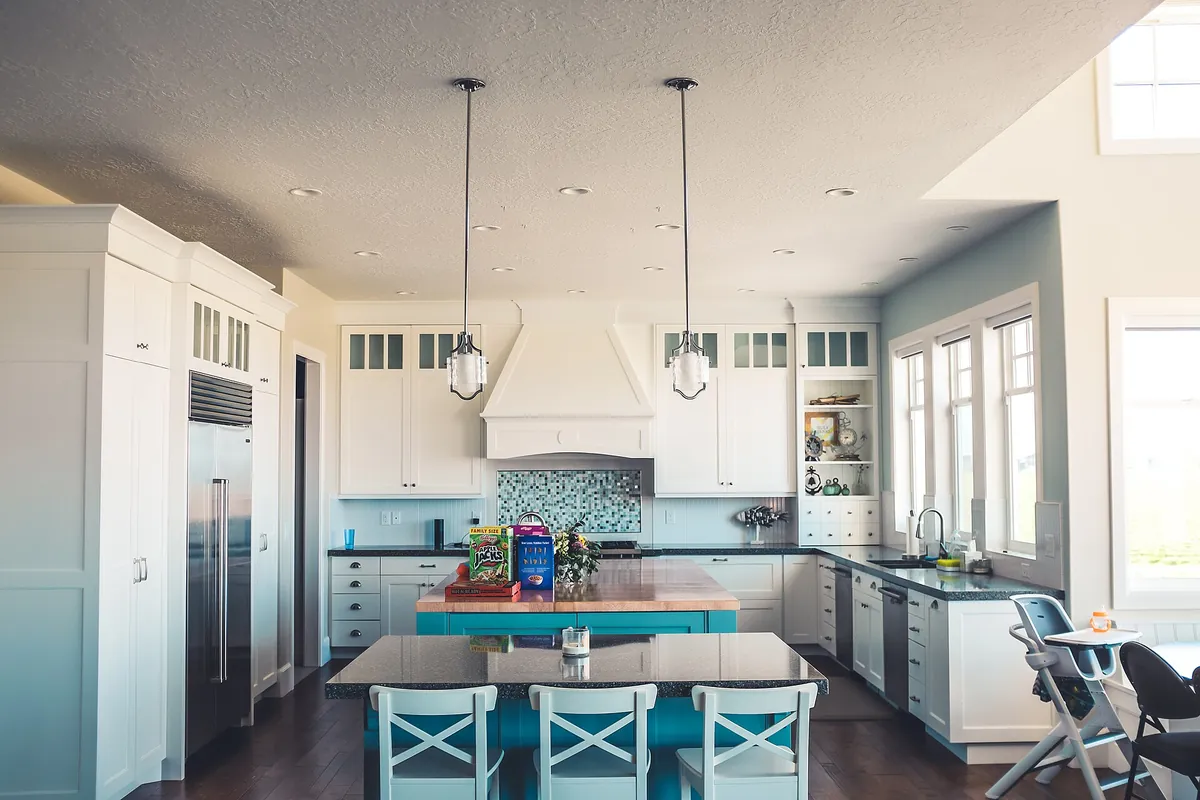
You can identify what you already have in about two minutes. Look at three places: where the base cabinet run meets a wall, the end of any run, and the gap beside the refrigerator. If you see a strip of matching material, typically two to four inches wide, closing a gap, you have stock cabinets. That strip exists because the catalogue widths did not add up to the length of your wall.
Confirm it by measuring a few cabinet widths. If they are all multiples of three inches, that settles it. Custom cabinets produce no filler strips at all, because the cabinets were sized to the wall rather than the other way around.
In an Antelope Valley tract kitchen, that filler strip is usually two to four inches of dead wall in the least useful position in the room, and it has been dead for the life of the house. Recovering it across a full run is frequently a whole extra drawer bank, which is the practical case for building to measured dimensions rather than to increments. More on that on the kitchen cabinets page.
Stock: What It Is Genuinely Good At
Stock cabinets are made in volume, held in inventory and shipped quickly, which gives them three real advantages: price, availability and predictability. If a kitchen is being turned around on a short timeline, or if it is a rental, or if the walls happen to suit the increments, stock is not a compromise, it is the efficient answer.
Published Los Angeles County pricing puts budget cabinetry at $75 to $150 per linear foot, and Thumbtack puts stock installed at $75 to $400 and up per linear foot. Those numbers are real and they are a long way below the alternatives. On a 25 foot tract kitchen the stock band works out at roughly $1,875 to $10,000 installed, against $12,500 to $37,500 for cabinetry alone at the LA custom band.
Its limits are dimensional rather than qualitative. Fixed widths mean filler strips. Fixed depths mean a drain that protrudes becomes a problem. Fixed heights mean a low soffit forces a gap or a furred down bulkhead. None of those are quality failures, they are the consequence of a catalogue meeting a house.
Semi Custom: The Tier Most Kitchens Actually Need
Semi custom starts from a catalogue and opens up a defined set of modifications. Which modifications varies substantially between manufacturers, which is why the useful question is never "is it semi custom" but "which modifications does this line allow?"
Typically available: width changes in one inch or smaller increments, a wide finish range, door style choice across the line, and a good range of interior fittings. Typically restricted: depth changes, unusual heights, and anything geometrically unusual.
Published pricing gives semi custom the widest band of any tier, $150 to $650 per linear foot, which reflects how much variation the category contains. Thumbtack puts semi custom cabinetry at $150 to $900 per linear foot nationally and its installed cost at the same $150 to $900 and up per linear foot, which is the honest signal that on this tier the cabinets dominate the number and the fitting is a minority of it. If your complaint list is widths and finishes, and in most Antelope Valley tract kitchens it is, this tier covers it.
Custom: When Nothing Else Fits
Custom means field dimensions throughout. Every cabinet is built to a number measured off your wall, which removes the filler strip, the depth conflict and the height conflict simultaneously, and allows geometry a catalogue cannot express.
It is also the only tier that can match an existing run exactly, because in that situation the existing run is the specification and no catalogue contains it. And it is the tier that lets you specify construction independently: box material per location, door construction, groove depth, moisture content of the stock. That last point matters more in the Antelope Valley than most places, for reasons covered in the materials guide.
| Tier | Per linear foot | Note |
|---|---|---|
| Budget | $75 to $150 per LF | Stock territory |
| Semi custom | $150 to $650 per LF | The widest band, and the one most kitchens land in |
| Premium | $300 to $800 per LF | Better carcases and hardware, more layout freedom |
| Luxury and full custom | $500 to $1,500+ per LF | Field dimensions throughout |
Source: Bradco Kitchens, Los Angeles custom cabinet pricing guide, updated 10 July 2026. Lancaster sits inside Los Angeles County.
Where Each Tier Stops
The most useful version of this comparison is not a feature list, it is a list of specific situations and which tier fails at each.
| Situation | Fails at | Note |
|---|---|---|
| A cabinet at a non catalogue width | Stock | Semi custom usually handles this. It is the most common reason to leave stock |
| Non standard height under a low soffit | Stock and most semi custom | Height modification is where semi custom catalogues vary most |
| Extra depth to clear a protruding drain | Stock and most semi custom | Depth is the modification catalogues allow least often |
| An angle other than ninety degrees | Both | Almost always custom territory |
| A single unit spanning a bulkhead and a window return | Both | Custom |
| A specific interior fitting the catalogue does not carry | Stock | Semi custom often can. Ask before assuming |
| Matching an existing run exactly | Both | Custom, because the existing run is the specification |
The Antelope Valley Caveat That Applies to All Three
Whatever tier you buy, one question applies equally. The USDA Forest Service Wood Handbook sets recommended interior moisture content at an average of 6 percent for the dry southwestern zone, with individual pieces between 4 and 9, against 8 percent for most of the United States and 11 percent for damp warm coastal areas. Lancaster averages 6.81 inches of precipitation a year at 2,359 feet.
A catalogue cabinet built and warehoused for a national market is dried to the national default, which is two points wetter than this valley wants. That is not a reason to reject semi custom or stock. It is a reason to ask, of any tier, whether the door centre panels float in their grooves rather than being glued in place, because a floating panel absorbs that difference and a glued one puts it into a joint. The wood species guide converts the difference into inches, species by species.
Availability and Lead Time, Which the Tiers Also Decide
Cost is not the only axis the tiers move along. They also determine how quickly you can have the kitchen, and for some households that matters more.
Stock is held in inventory, which is the entire point of it. It ships quickly and predictably, and a kitchen can be on site in a fraction of the time a built to order one takes. Where a house is being sold, let, or turned around on a deadline, that is a genuine advantage rather than a consolation.
Semi custom is made to order from standard components, so it sits between the two. The catalogue exists and the parts exist; what takes time is configuring and finishing them to your selections.
Custom is built from sheet goods and lumber after your drawing is approved. Nothing exists until it is made, which is why the design and approval stage, and not the building, is usually the longest part of the project. The timeline guide sets out all five stages and what drives the length of each.
One shared constraint worth knowing: whichever tier you buy, the counter cannot be templated until the base cabinets are installed, levelled and secured, and the fabrication time after that belongs to the counter fabricator. That step is identical across all three tiers and nobody on the cabinet side can compress it.
The Tiers and Partial Replacement
A situation the tier comparison usually ignores: you are not rebuilding a kitchen, you are adding to one or replacing part of it. That changes the ranking.
Custom is the only tier that can match an existing run exactly, because in that situation the existing run is the specification and no catalogue contains it. Dimensions, overlay, reveal, door profile and finish all have to be reproduced from what is already on your wall.
Finish is the hard half. Finishes age, and they age unevenly on any run that takes hard afternoon light, which in Lancaster is most west facing kitchens. A sample has to be made and held against the existing work in the actual room, in daylight, before a batch is committed. Paint is far more forgiving than stain here for the obvious reason that it covers the wood entirely, which is why partial replacement in a painted kitchen is a routine job and partial replacement in an aged stained kitchen frequently is not.
Where an exact match proves impossible, replacing a whole elevation or a whole run generally looks better than a near miss standing directly beside the original.
Mixing Tiers, Which Is Often the Smartest Spend
There is no rule that one kitchen has to come from one tier. A sensible mix is stock or semi custom for the straightforward runs where a catalogue width happens to land, and custom for the awkward pieces: the corner, the tall pantry, the unit spanning a bulkhead, the island.
The constraint is matching. Door style, overlay type, reveal dimension and finish all have to line up across the mix, or the kitchen reads as two kitchens. That is considerably easier in paint than in stain, for the obvious reason that paint covers the wood. Raise it explicitly at quote stage rather than assuming a shop will propose it.
How to Decide, in Order
- Write down what specifically annoys you about the current kitchen, in plain language.
- Sort that list into dimensional complaints and cosmetic ones.
- Run the filler strip test to establish what you currently have.
- If the list is only cosmetic, consider refacing or new doors rather than any new cabinetry.
- If it is widths and finishes, price semi custom and custom against each other.
- If it includes depths, heights, angles or matching existing work, it is custom.
- Whatever the tier, ask about carcase material per location, door construction and hardware separately.
- Ask specifically whether door centre panels float, because that question is tier independent.
- Consider mixing tiers, and raise the matching question if you do.
Where to Go Next
If the answer is custom, the custom cabinets page covers the six decisions that move a quote. If your complaints were all cosmetic, read the refacing versus replacing guide before spending anything. For the numbers in full, the cost guide has every published range with its source. Or send the complaint list and the town.