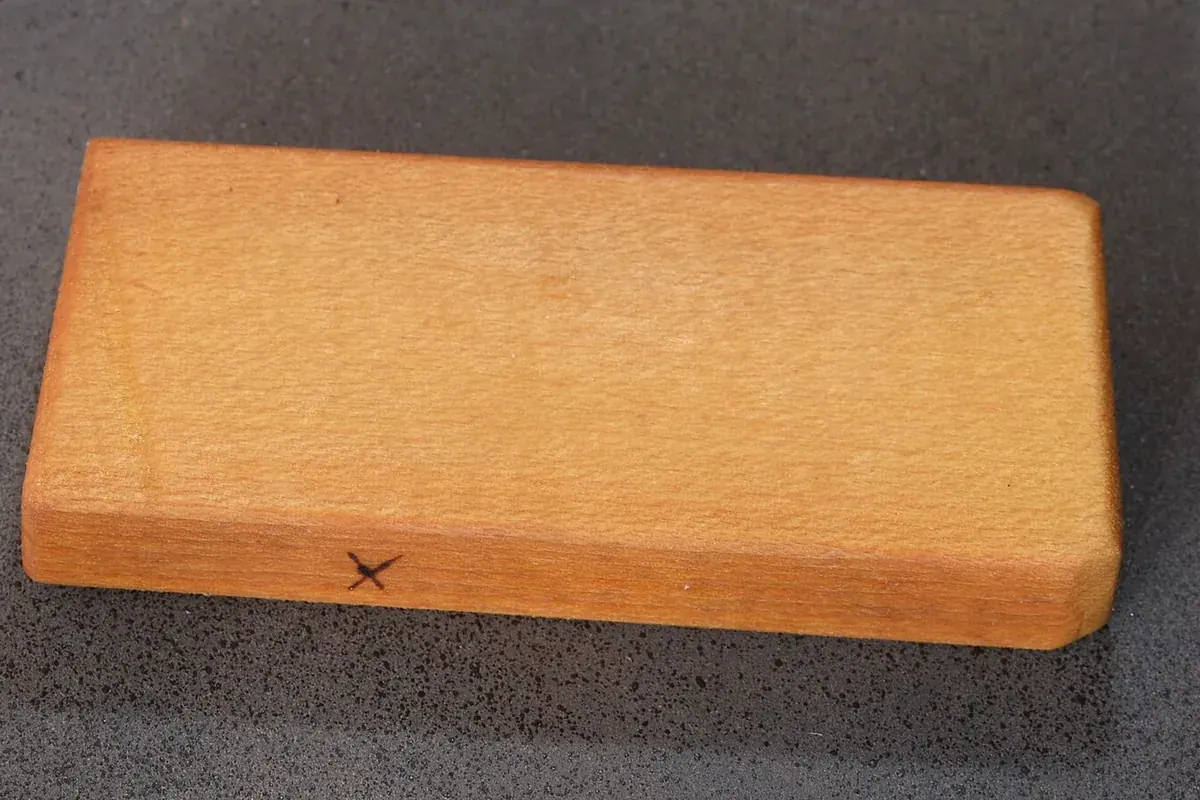
Why Paint Costs More: the Sequence
The price difference is not positioning, it is operations. Here is what each schedule actually involves.
| Finish | Typical sequence | Operations | Relative cost |
|---|---|---|---|
| Stained clear finish | Sand, stain, seal, sand lightly, topcoat | 3 to 4 operations | Lower |
| Painted finish | Sand, fill, prime, sand, colour coat, colour coat, often a clear over | 6 to 7 operations | Higher |
| Glazed | A painted or stained schedule plus a glaze coat worked by hand, then sealed | Painted schedule plus 2 | Highest, and the least repeatable |
| Two tone | Two complete schedules run separately on different components | Both schedules | Effectively two finishing jobs |
Two things drive the gap. First, count: six or seven operations against three or four. Second, tolerance. A dust nib or a sag in a stained topcoat can often be cut back and blended. The same defect in a colour coat means the panel goes back to the start of the colour sequence, because a partial recoat shows. On a profiled door style, every profile has to be coated evenly without building up in a corner, which is where sags happen. The door styles guide covers which styles have the most profile to manage.
What Each Finish Hides and What It Shows
This is the practical decision, and it is not about taste. Each finish conceals a different category of imperfection.
| Condition | Better hidden by | Why |
|---|---|---|
| A mix of species in one door | Paint | Stain shows every colour and grain difference between parts |
| Filled joints and minor repairs | Paint | Stain makes filler obvious, sometimes more obvious than the defect |
| Wear at a handle over years | Stain | Paint chips visibly at an edge. Stain wears gradually and can be touched in |
| A dent or a knock | Stain | A stained surface can be sanded and re-blended. Paint has to be recoated to a break |
| Grain in an open grained species | Stain | Paint telegraphs oak grain unless it is filled, which is extra labour |
| A partial replacement matched to existing work | Paint | Matching a stained run that has aged in sunlight is close to impossible |
Two rows deserve emphasis. Paint hides a mix of species in one door, which is why it makes partial replacement and mixed tier kitchens practical. And stain hides long term wear better, because a stained surface wears gradually and can be touched in, while paint chips at an edge in a way the eye finds immediately.
Species Choice Follows the Finish
Deciding painted or stained first is not an arbitrary ordering rule, it genuinely narrows the sensible species list.
For paint: close grained species
Yellow-poplar and soft maple have an even, tight grain that does not telegraph through a paint film. A great deal of expensive painted cabinetry is poplar underneath, and that is the correct choice rather than a saving. Open grained species like red and white oak show their grain through paint unless the grain is filled, which is a genuine extra labour cost on every square foot.
For stain: species worth looking at
Red alder takes stain evenly without blotching and is the value choice. Black cherry and black walnut are worth showing as they are and need very little colour. Hard maple can blotch without a conditioner, which is a known and solvable problem but one to ask about. Both oaks take stain with real character because the open grain holds pigment.
The wood species guide ranks all of these on the other axis that matters here, which is how much each one moves.
The Rule That Governs Finishing in the Antelope Valley
Any commercial shop spraying cabinets in this valley works under Antelope Valley Air Quality Management District Rule 1136, Wood Products Coatings, adopted 16 September 1983 and last amended 14 June 1996. Its stated purpose is to reduce volatile organic compound emissions from the application of coatings or strippers to, and surface preparation of, any wood products, including furniture, cabinets, shutters, frames and toys.
| Coating category | Limit |
|---|---|
| Clear sealers | 275 g/L |
| Clear topcoat | 275 g/L |
| Pigmented primers, sealers and undercoats | 275 g/L |
| Pigmented topcoats | 275 g/L |
| High solid stains | 350 g/L |
| Low solid stains, toners and washcoats | 120 g/L of material |
Grams per litre less water and less exempt compounds, except where stated as grams per litre of material. Strippers may not exceed 350 g/L of material, or must have a composite vapour pressure of 2 mm Hg or less at 68F.
Two consequences follow. First, if you are buying a finish from a local shop, it will be waterborne or high solids, because those are the chemistries that meet 275 grams per litre. That is not a compromise: modern waterborne and high solids coatings generally beat the solvent lacquers they replaced for hardness and for yellowing resistance.
Second, the rule says explicitly that it "shall not apply to residential noncommercial operations." A homeowner refinishing their own doors in their own garage is outside it entirely. That is worth knowing before somebody tells you otherwise.
The West Facing Kitchen Problem
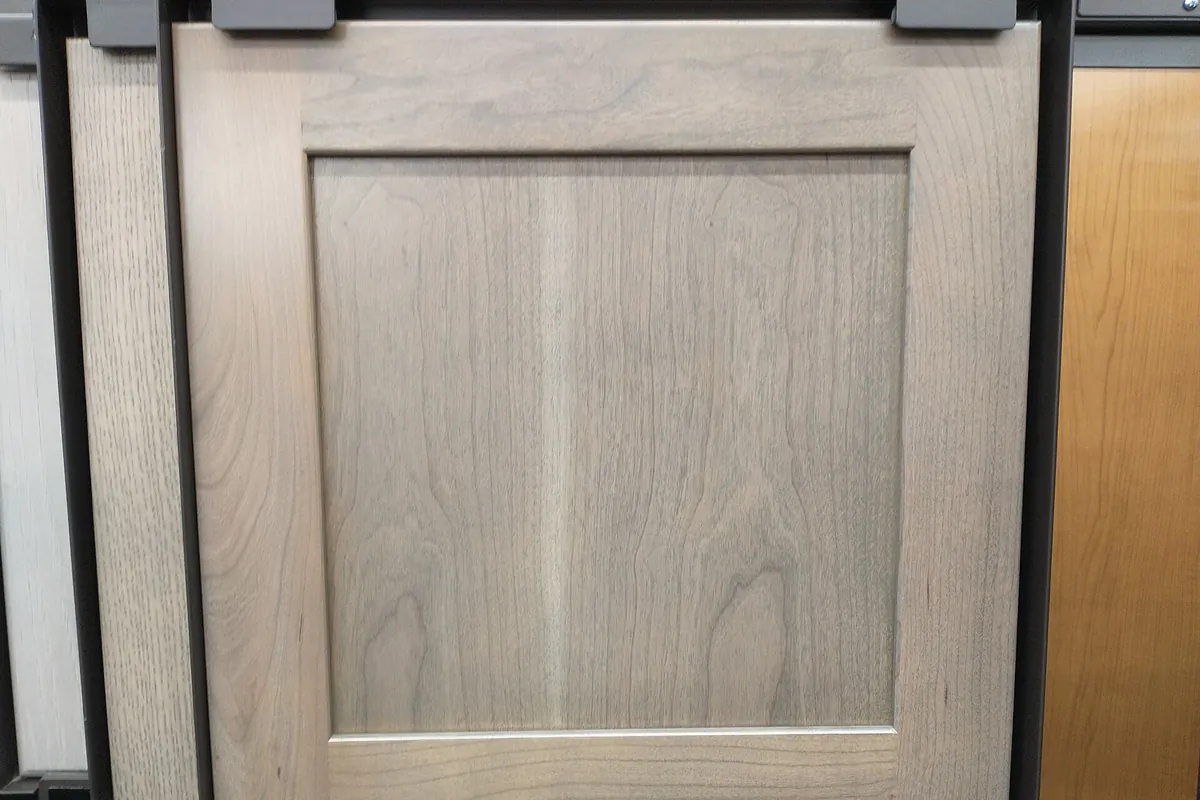
Almost every Antelope Valley house gets strong, direct, late afternoon sun, and in a great many of them it comes through a kitchen window. That matters for finish in two ways.
Stains and clear coats shift over years under ultraviolet exposure, and some species change on their own regardless of finish. Black cherry darkens markedly with light exposure and will do so faster and less evenly where afternoon sun falls on one section. If you put a small appliance on a run and leave it there for two years, you will find its outline underneath when you move it.
Paint is more colour stable but not immune, and a highly polished sheen will show every fingerprint and every dust mark at four in the afternoon when the light is raking across it. Satin and matte sheens hide both. If the room takes hard afternoon light, sheen choice is a more consequential decision than colour.
Does a Finish Crack in Dry Air?
A finish film does not crack on its own; it cracks because the wood underneath it moved. That makes this a construction question wearing a finish costume.
Lancaster averages 6.81 inches of precipitation a year at 2,359 feet. The USDA Forest Service Wood Handbook puts recommended interior moisture content for the dry southwestern zone at an average of 6 percent with individual pieces between 4 and 9, against 8 percent for most of the United States and 11 percent for damp warm coastal areas. A panel that arrives wetter than that and settles here has to lose width.
In a five piece door with a floating centre panel, that movement goes into the groove and nothing happens. In a door with the panel glued in, it goes into the joint, and the finish film over that joint is the most visible casualty. A paint film is generally less flexible than a clear coat, so it shows it sooner. The answer is not a softer paint, it is a floating panel. The materials guide covers the construction side in full.
Sheen Matters More Here Than Colour Does
Sheen is how much light a finish reflects, and it is the decision people spend the least time on and notice the most afterwards. In a valley where strong, raking afternoon light reaches most west facing kitchens, it deserves more thought than the colour.
| Sheen | What it shows | Where it suits |
|---|---|---|
| Matte and flat | Hides fingerprints, dust and surface imperfection best | High traffic kitchens, painted finishes, anything in hard afternoon light |
| Satin and eggshell | The usual compromise. Some sheen, forgiving in use | The default for most cabinet work, painted or stained |
| Semi gloss | Wipes down easily, shows more | Bathrooms and laundries where washability matters most |
| Gloss | Shows everything: dust, prints, and every flaw in the substrate | A deliberate statement, and a commitment to wiping |
One practical note about substrate. A high sheen finish magnifies whatever is underneath it, so a gloss painted door needs a flatter, better prepared surface than a matte one to look right. That is part of why gloss costs more on the same door: the preparation is longer, not just the coating.
Touching Up and Repairing Each Finish
Every cabinet finish gets damaged eventually. What differs is how easily it can be put right, and this is where the two diverge most sharply over a twenty year life.
Stain and clear
A stained surface can usually be sanded locally and re-blended, because the colour lives in the wood rather than on it and the topcoat can be feathered. Scratches in a clear coat often disappear with careful work. The limit is a veneered surface, where the veneer is thin enough that aggressive sanding goes through it, and that limit arrives faster than people expect.
Paint
A paint film has to be recoated to a break, which on a door means the whole door and on a face frame usually means the whole run. A touch up dab on a painted surface is visible from an angle almost immediately. The compensating advantage is that repainting is straightforward: degrease, sand, prime, recoat, and the colour can change entirely at the same time.
Glaze
The hardest of the three to repair, because a glaze is worked by hand and therefore is not repeatable in the way a sprayed coat is. Matching a glazed finish on a single replacement door some years later is genuinely difficult, which is worth knowing before committing a whole kitchen to one.
Glazes, Two Tone and Other Add-Ons
A glaze is a coloured layer applied over a base and then worked by hand, usually to accentuate profiles and corners, before being sealed. It is the least repeatable finishing operation in cabinetry, because it depends on hand technique rather than on spray settings. That has two consequences: it costs more, and matching it later on a replacement door is genuinely difficult.
Two tone schemes, a painted perimeter with a stained island being the common one, are simply two complete finishing schedules run separately. Price them as such. The visual payoff is real and the cost is not hidden.
Deciding
- Decide which failure you mind more: a visible chip, or a gradual colour change.
- Look at the room's light. Hard west light argues for a satin or matte sheen whichever finish you pick.
- If any part of the job is a partial replacement matched to existing work, paint is far more forgiving.
- Match the species to the finish: close grained for paint, character species for stain.
- Ask how many coats and what is sanded between them, not which brand.
- Confirm panels float, because that decides whether the finish ever sees stress at a joint.
- Ask whether panels are finished before assembly, so a shrink line is coated rather than raw.
- Price glaze and two tone as the extra schedules they are.
- Get a finished sample and look at it in your own kitchen at the time of day the light is worst.
Sources
- Antelope Valley AQMD Rule 1136, Wood Products Coatings →
Purpose and applicability, the residential noncommercial exemption, and the VOC limit table reproduced above.
- AVAQMD Regulation XI, Source Specific Standards →
The rule index where Rule 1136 and its neighbours sit.
- USDA Forest Service Wood Handbook, Chapter 13 →
The moisture content zone targets behind the cracking section above.
Where to Go Next
For the door the finish goes on, read the door styles guide. For which species suit each finish, the wood species guide. For where finish sits in a whole cabinet budget, the cost guide. And if you are changing finish on existing cabinets rather than buying new, see refacing.