First, Work Out What You Already Have
Two observations take thirty seconds and determine the entire upgrade path.
Open any door and look at the hinge. If you cannot see it when the door is closed and it sits in a round bored cup on the back of the door, you have concealed European hinges, which adjust in three directions and can usually be swapped for soft close versions directly. If you can see a knuckle or a plate, you have semi concealed or surface mounted hinges, and moving to concealed means boring the doors, which is shop work.
Then pull a drawer all the way out. If it stops with the last few inches still inside the cabinet, you have three quarter extension roller runners, which is what almost every builder kitchen in the Antelope Valley was fitted with. Replacing them with full extension slides makes the back of every drawer reachable for the first time, and it is the single most transformative hardware change in a kitchen.
Hinges, Compared Honestly
| Type | What it does | Verdict |
|---|---|---|
| Concealed European, soft close | Adjusts in three directions, invisible when closed, closes quietly | The current baseline. Worth the money on every door in the house |
| Concealed European, standard | Same adjustability, no damper | Fine. A separate clip on damper can be added later |
| Semi concealed face frame | Visible knuckle, limited adjustment | Traditional look. Harder to keep reveals even across a run |
| Surface mounted butt and strap | Entirely visible, decorative | A style choice. Adjustment is by re-drilling, which is to say none |
| Inset hinges | For doors that sit inside the frame rather than over it | Beautiful and unforgiving. Every reveal is visible on all four sides |
One climate specific note. Lancaster sees roughly a 30 degree daily temperature swing, between a mean daily maximum of 77.1F and a mean daily minimum of 47.1F, and averages 6.81 inches of precipitation a year. Solid wood door frames move a little with seasonal change even when built correctly for the dry southwestern moisture target. Concealed hinges adjust in three directions precisely so a run can be trued up again, which in this climate is a real argument for adjustable hinges over fixed decorative ones.
Drawer Slides
| Type | What it does | Where it belongs |
|---|---|---|
| Undermount, full extension, soft close | Invisible under the drawer, full access to the back, closes quietly | The current baseline for anything you open daily |
| Side mount ball bearing, full extension | Visible at the drawer sides, full access, usually heavier rated | Perfectly good, and the honest choice for a garage or workshop |
| Side mount epoxy roller, three quarter extension | The cheapest option and the one in most builder kitchens | The back of the drawer is permanently out of reach |
| Heavy duty, rated by load | For pan drawers, tool drawers and anything genuinely heavy | Rated in pounds. Check the rating rather than trusting the description |
| Pull out shelf slides | For roll outs inside a door base cabinet | Costs about an inch of usable width per shelf |
Undermount slides are the current kitchen baseline for good reasons: they are invisible, they give the drawer box its full width, and the soft close is built in. They also require a drawer box built for them, with a specific bottom panel thickness and a notch at the rear, which is why converting a box made for side mount runners is usually not possible without a new box. Side mount ball bearing slides are not a compromise, they are the right answer in a garage or a workshop where load rating matters more than invisibility.
Pulls, Knobs and Setting Out
Pull or knob
Knobs suit doors, pulls suit drawers, and the reason is leverage: a drawer is opened against friction and a pull gives you a hand. A heavy pan drawer with a single small knob is an irritation you will feel daily. Pulls also work better anywhere hands are wet, which is an argument for pulls in a bar, a laundry and at a sink base.
Setting out beats centring
Handles are positioned to a consistent rule across a whole run, not centred on each door individually. The eye reads the horizontal line of handles along a run of differing cabinet widths, so consistency in the setting out is what looks right. Centring each handle on its own door produces a line that wanders, which looks wrong even to people who cannot say why.
Finish and fingerprints
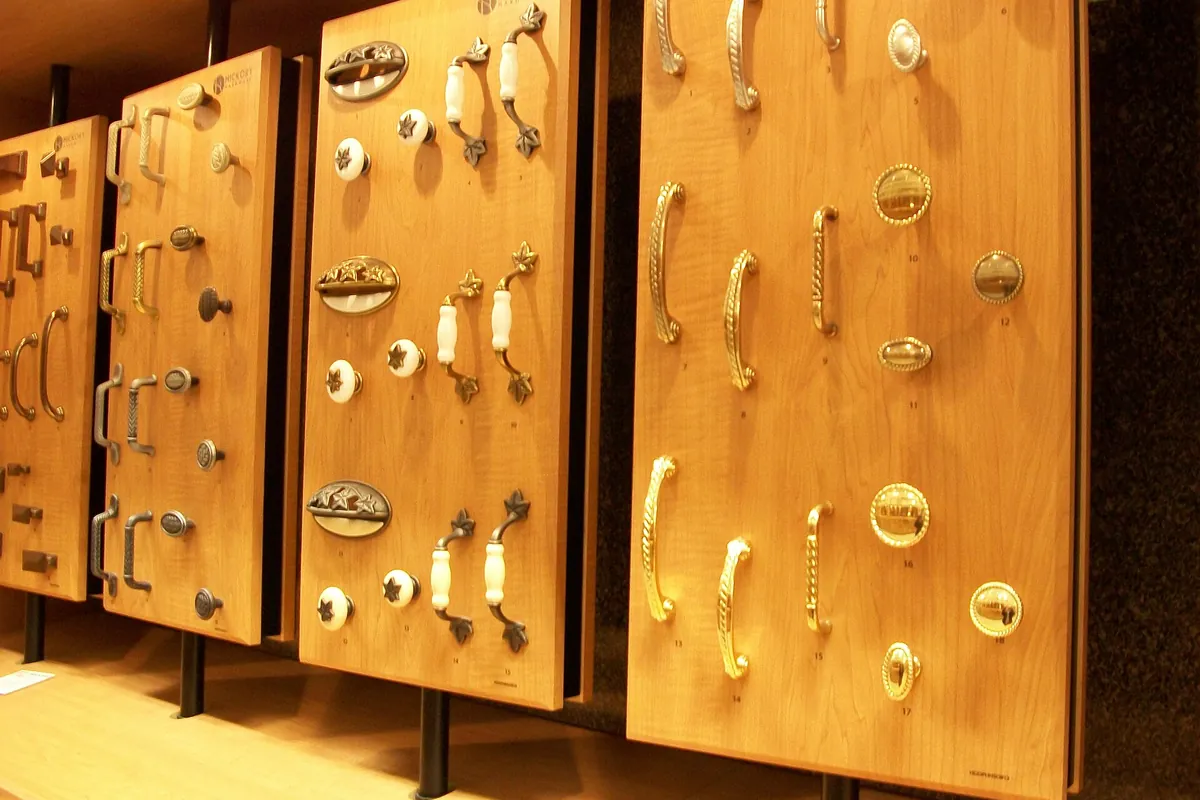
The practical differences between finishes are fingerprint visibility and how they age. Polished finishes show everything, brushed and satin finishes hide most of it, and unlacquered living finishes change over time deliberately. In a Lancaster kitchen with strong afternoon light through a west window, a highly polished finish will show every mark at four in the afternoon.
Interior Fittings Are Hardware Too
Waste pull outs, roll out shelves, tray dividers, corner mechanisms and drawer inserts are all hardware decisions with a cost in internal volume as well as in money. A roll out shelf costs about an inch of usable cabinet width. A corner mechanism costs a surprising amount of the corner it is meant to recover. Those trades are worked through in detail in the organization and fittings guide, including which mechanisms people actually keep using after the first year.
Why Function Comes Before Finish
The common sequence is backwards: people pick a handle finish they like, then discover the budget for slides has gone, and end up with a beautiful kitchen whose drawers only open three quarters of the way. Handles are the most visible hardware and the easiest to change later, which makes them a poor place to spend first and a fine place to defer.
The order that works is: soft close and full extension first, adjustability second, load rating third where it matters, finish last. If something has to be cut, cut the handles and change them in a year.
What to Specify on a Hardware Quote
- Hinge type stated explicitly, with soft close confirmed as included or excluded.
- Cup diameter and cup to edge dimension, measured on your existing doors if reusing them.
- Overlay type and the reveal dimension the run is built to.
- Slide type, extension and soft close, stated per drawer rather than as a blanket note.
- Load rating in pounds for anything carrying pans, tools or heavy stock.
- Handle setting out rule for the run, not just the handle model.
- Interior fittings listed per cabinet: waste pull out, roll outs, tray dividers, corner mechanism.
- Whether adjustment after installation is included, and whether a return visit is included.
How a Hardware Job Runs
- 1Work out what you actually have
Open a door and look at the hinge. A concealed European hinge sits in a bored cup on the back of the door, and it adjusts in three directions. A surface mounted or semi concealed hinge does not. Then pull a drawer fully out: if it stops three quarters of the way, you have side mount runners rather than full extension undermount slides. Those two observations determine the whole upgrade path.
- 2Measure the hinge bore and the overlay
Cup diameter and the distance from the cup centre to the door edge. Then the overlay, which is how much of the face frame each door covers. New hinges have to match both or the doors will sit proud, sit deep, or refuse to close. Guessing this is the most common reason a hardware swap goes wrong.
- 3Measure the drawer box, not the opening
Slide length is set by the drawer box depth and the cabinet depth behind it, and slide type is set by the drawer box construction. Undermount slides need a drawer box with a specific bottom thickness and a notch at the rear, which means a box built for side mount runners usually cannot simply be converted.
- 4Choose function first, finish second
Soft close, full extension and adjustability are functional decisions you live with daily. Finish is aesthetic and reversible. People do this in the wrong order constantly, choosing a handle finish first and then discovering the budget for slides has gone.
- 5Fit and adjust across the run, not per door
Handles are set out to a consistent rule across a whole run rather than centred on each door individually, because the eye reads the line rather than each door. Hinges are then adjusted in all three axes until every reveal matches, and slides are adjusted for height and tilt. A hardware job is finished at the adjustment stage, not at the fitting stage.
Where to Go Next
If the doors are tired as well as the hardware, see doors and drawer fronts or refacing, both of which include new hardware as a matter of course. For heavy duty hardware in a punishing environment, see garage cabinets. For how hardware sits inside a whole cabinet budget, read the cost guide. Or send a photo of an open door and the town.