Why Movement, Not Hardness, Is the Right Ranking Here
Hardness tells you how a cabinet survives a dropped pan. Dimensional stability tells you whether a door is still square in five years. In a climate as dry as the Antelope Valley, the second question matters more, because the gap between where wood is usually dried and where it will live is unusually wide.
The USDA Forest Service Wood Handbook, FPL GTR-190, sets the interior moisture target for this region at an average of 6 percent with individual pieces between 4 and 9, against 8 percent for most of the country and 11 percent for damp warm coastal areas. Lumber for furniture, cabinets and millwork is normally dried to 7 to 9 percent. A panel arriving at the top of that range and settling at 6 percent has to lose width, and how much it loses depends entirely on the species.
The Numbers, Straight From Table 13-5
The Wood Handbook publishes a dimensional change coefficient for each species in two directions: radial (across a quartersawn face) and tangential (across a flat sawn face). Tangential is the larger figure and the one that governs a normal flat sawn panel. The movement column below is computed with the Handbook's own equation 13-2 for a 12 inch wide flat sawn panel going from 10 percent to 6 percent moisture content.
| Species | Radial (CR) | Tangential (CT) | Width lost |
|---|---|---|---|
| Alder, red | 0.00151 | 0.00256 | 0.123 in |
| Cherry, black | 0.00126 | 0.00248 | 0.119 in |
| Maple, bigleaf | 0.00126 | 0.00248 | 0.119 in |
| Walnut, black | 0.00190 | 0.00274 | 0.132 in |
| Maple, red (soft) | 0.00137 | 0.00289 | 0.139 in |
| Yellow-poplar | 0.00158 | 0.00289 | 0.139 in |
| Maple, sugar (hard) | 0.00165 | 0.00353 | 0.169 in |
| Oak, white (commercial) | 0.00180 | 0.00365 | 0.175 in |
| Oak, red (commercial) | 0.00158 | 0.00369 | 0.177 in |
| Hickory, true | 0.00259 | 0.00411 | 0.197 in |
| Beech, American | 0.00190 | 0.00431 | 0.207 in |
Coefficients from USDA Forest Service Wood Handbook FPL GTR-190, Table 13-5, valid within 6% to 14% moisture content. Movement computed as 12 x CT x 4 using the Handbook's equation 13-2. Listed in ascending order of movement.
Why There Are Two Columns, and When the Smaller One Applies
Wood moves roughly twice as much tangentially as radially. Commercial red oak is the clearest example in the table: 0.00369 tangential against 0.00158 radial, a ratio of more than two to one. Which figure applies depends on how the board was cut from the log.
A flat sawn board presents the tangential face across its width, so it uses the larger coefficient. A quartersawn board presents the radial face, so it uses the smaller one and moves less than half as much. That is the real, physical reason quartersawn stock costs more, and it is also why quartersawn white oak became the traditional choice for furniture built to last.
Whether it is worth paying for in a cabinet is a different question. Since good construction already lets panels float, quartersawing generally buys you appearance, the ray fleck in white oak most obviously, rather than a performance you needed. Where it genuinely earns its cost is a wide solid panel that cannot float, such as a solid slab door or a solid end panel.
Choosing by What the Cabinet Is For
| Application | Sensible species | Why |
|---|---|---|
| Paint grade doors and frames | Yellow-poplar, soft maple | Close grain that does not telegraph through paint, moderate movement, economical |
| Clear finished contemporary | Red alder, maple, walnut | Even colour or strong figure depending on the look. Alder is the value option |
| Traditional stained | Red oak, white oak, cherry | Open grain that takes stain with character. Both oaks move most, so panels must float |
| Very hard wearing | Hard maple, hickory | Best abrasion resistance of the common species, and the most movement to design around |
| Warm and ageing | Black cherry, black walnut | Both darken with light exposure. Cherry moves notably little for a hardwood |
| Carcases and interiors | Engineered panel, not solid | Cross laid or pressed construction sidesteps the movement question entirely |
Paint grade: poplar and soft maple
Both have a close, even grain that does not telegraph through a paint film. Open grained species like oak do telegraph, and hiding that means grain filling, which is real extra labour on every square foot. Yellow-poplar sits at 0.00289 tangential and soft red maple at the same figure, both comfortably mid range for movement. A great deal of expensive painted cabinetry is poplar underneath, and that is not a compromise, it is the correct choice.
Value clear finish: red alder
Alder is softer than maple, which is its only real drawback, and in exchange it takes stain evenly without the blotching that plagues some species, it is widely available, and at 0.00256 tangential it is among the more stable common cabinet woods. For a clear or lightly stained kitchen on a normal budget it is difficult to beat.
Hard wearing: hard maple and hickory
Sugar maple and true hickory are the abrasion champions of the common cabinet species, and they are also two of the biggest movers in the table, at 0.00353 and 0.00411 tangential. That is not an argument against them, it is an argument for floating panels and generous grooves when you use them. Hickory in particular has dramatic colour variation, which people either love or regret.
Woods that change: cherry and walnut
Black cherry darkens substantially with light exposure, and in a Lancaster kitchen with strong afternoon light through a west window it will do so faster and more unevenly than in a coastal house. That is a feature if you want it and a problem if you place a shelf on a door and leave it there. Walnut moves in the other direction, lightening and mellowing. Both are stable: cherry at 0.00248 tangential is among the least mobile species in the table, and walnut at 0.00274 is close behind.
The Option That Sidesteps the Whole Argument
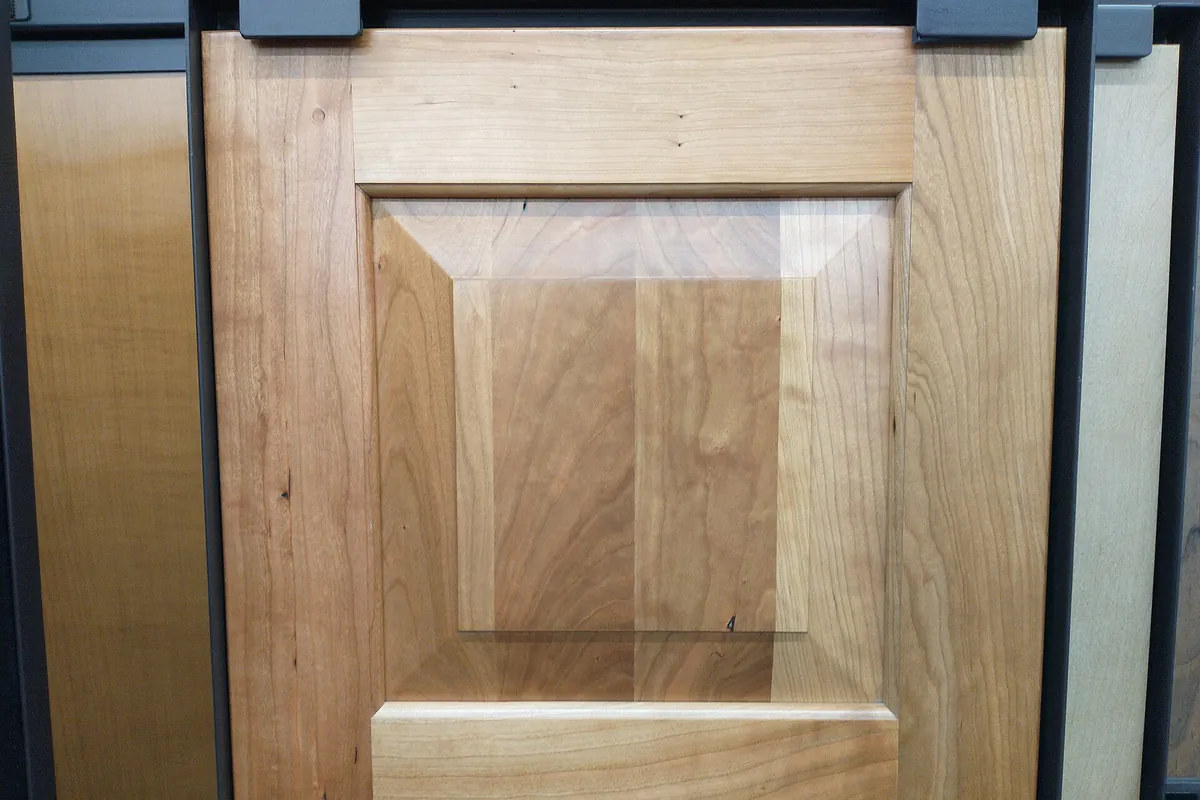
A veneered engineered panel has a thin layer of real wood over a stable core, which means it looks like the species and behaves like the core. For wide panels, carcase sides, end panels and slab doors this is frequently the best answer in a dry climate, and Thumbtack's national data reflects its value position: a standard kitchen in wood veneer runs $1,900 to $13,000 against $5,000 to $25,000 in solid wood.
The trade is repairability. A solid panel can be sanded and refinished indefinitely; a veneer can be refinished carefully once or twice and then it is done. For most kitchens that trade is worth making, and the solid wood belongs in the frames, the face frames and the mouldings where it is narrow and its movement is trivial.
A Wider Table, for Anything Unusual
The first table covers the species a cabinet shop will actually offer. If somebody proposes something less common, or you have reclaimed stock you want used, here are more of Table 13-5's figures with the same 12 inch panel calculation applied.
| Species | Radial (CR) | Tangential (CT) | Width lost |
|---|---|---|---|
| Catalpa, northern | 0.00085 | 0.00169 | 0.081 in |
| Sassafras | 0.00137 | 0.00216 | 0.104 in |
| Butternut | 0.00116 | 0.00223 | 0.107 in |
| Chestnut, American | 0.00116 | 0.00234 | 0.112 in |
| Aspen, quaking | 0.00119 | 0.00234 | 0.112 in |
| Ash, white | 0.00169 | 0.00274 | 0.132 in |
| Elm, rock | 0.00165 | 0.00285 | 0.137 in |
| Sycamore, American | 0.00172 | 0.00296 | 0.142 in |
| Birch, paper | 0.00219 | 0.00304 | 0.146 in |
| Hickory, pecan | 0.00169 | 0.00315 | 0.151 in |
| Elm, American | 0.00144 | 0.00338 | 0.162 in |
| Birch, yellow | 0.00256 | 0.00338 | 0.162 in |
| Sweetgum | 0.00183 | 0.00365 | 0.175 in |
| Tanoak | 0.00169 | 0.00423 | 0.203 in |
| Oak, white, overcup | 0.00183 | 0.00462 | 0.222 in |
Coefficients from USDA Forest Service Wood Handbook FPL GTR-190, Table 13-5. Movement computed as 12 x CT x 4 using equation 13-2, listed in ascending order of movement.
Two extremes are worth noting. Northern catalpa at 0.00169 tangential barely moves at all, which is why it has historically been used where stability mattered more than hardness. Overcup white oak at 0.00462 moves nearly three times as much, and a 12 inch panel of it loses close to a quarter of an inch making the same transition. Neither is a common cabinet species, and both show how wide the range across the table actually is.
Working the Numbers Yourself
The Wood Handbook's equation is simple enough to use on a napkin, and being able to do so makes a conversation with a shop considerably more productive. The change in dimension equals the starting dimension multiplied by the dimensional change coefficient multiplied by the change in moisture content, and it is valid between 6 and 14 percent moisture content.
The Handbook's own worked example uses a flat sawn white fir board 9.15 inches wide at 8 percent moisture content. Moving to 11 percent, the change is 9.15 multiplied by 0.00245 multiplied by 3, which is 0.067 inches of growth. Run it the other way for a Lancaster kitchen and the sign flips: the same board losing three points of moisture content shrinks by the same 0.067 inches.
For a practical case, take a 16 inch wide flat sawn red oak raised panel, which is a realistic size for a large pantry door. Going from 10 percent to 6 percent: 16 multiplied by 0.00369 multiplied by 4 equals 0.236 inches, which is nearly a quarter of an inch across one panel. That is why the groove depth question in the materials guide is not pedantry. A panel with a quarter inch of engagement in a quarter inch groove will pull free of it.
How to Use This When You Are Actually Choosing
- Decide painted or clear first. Painted narrows you to close grained species; clear opens the field.
- Pick the species for colour, grain and hardness, because that is what you will look at for twenty years.
- Check where it sits in the movement table, and treat a high figure as a construction requirement rather than a veto.
- Insist on floating centre panels regardless of species, with a groove deep enough to allow the movement in the table.
- Ask what moisture content the stock was dried to. The dry southwestern interior target is an average of 6 percent.
- Use an engineered panel for anything wide: carcase sides, end panels, slab doors.
- Consider quartersawn only where a wide solid panel genuinely cannot float.
- Ask for a finished sample in the species and colour, viewed in your own kitchen light before committing.
Sources
- USDA Forest Service, Wood Handbook FPL GTR-190, Chapter 13: Drying and Control of Moisture Content and Dimensional Changes →
Table 13-5 supplies every coefficient in the table above. Equation 13-2 supplies the movement calculation. Table 13-2 supplies the 6 percent dry southwestern interior target.
- Thumbtack, custom cabinet cost data →
The solid wood, veneer and laminate bands for a standard kitchen quoted above.
Where to Go Next
The companion piece to this one is the materials guide, which covers carcase materials, the moisture zones in full and the local VOC rule. For how species interacts with the door you choose, read the door styles guide, and for the paint question specifically, the painted versus stained guide. To see it applied to a real room, see kitchen cabinets.