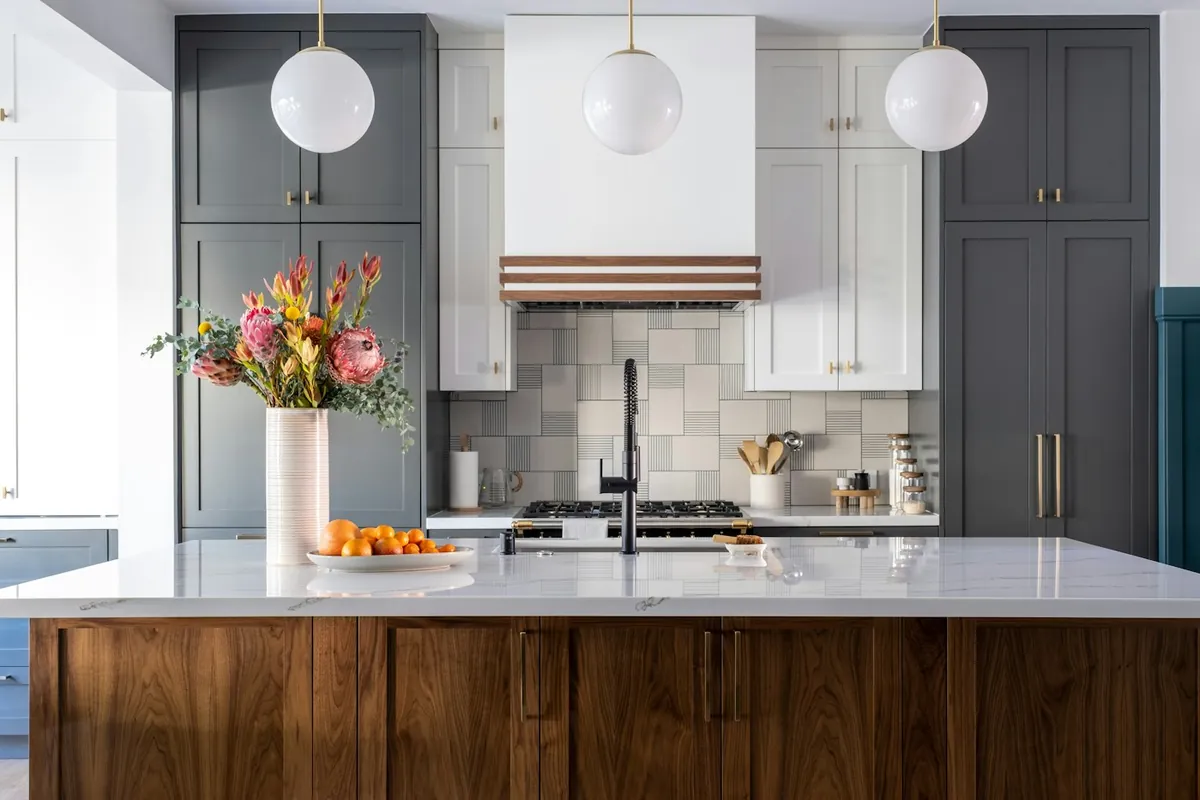
How much do custom cabinets cost in Lancaster, CA?
Budget $500 to $1,500 per linear foot for true custom cabinets, which is the Los Angeles market range published by LA cabinet makers, against a national range of $400 to $1,200 per linear foot. Lancaster sits inside Los Angeles County, so that is the nearest published benchmark, though Antelope Valley labour generally runs below the LA basin and quotes here tend to land in the lower half of the band. Nationally, Thumbtack records a typical custom cabinet project between $1,447 to $5,294 against an average of $2,817, a band that stretches that wide because one vanity and a whole kitchen sit in the same category. The only number that means anything is the one written down after somebody measures your room.
What does a kitchen of cabinets cost at Los Angeles County rates?
At the $500 to $1,500 per linear foot LA range, a 15 foot galley runs roughly $7,500 to $22,500, a 25 foot kitchen $12,500 to $37,500, a 35 foot kitchen $17,500 to $52,500, and a 50 foot plus layout can pass $75,000. Those totals come straight from the LA cabinet maker pricing guide that publishes the per foot band. Measure the run of base cabinets along the wall, in feet, and you have your linear footage. Labour is typically 20 to 30 percent of the total, so a shop that quotes cabinets and installation separately is not hiding anything, it is just splitting the same job.
Why do cabinet doors crack and joints open up in Antelope Valley houses?
Because wood built to the wrong moisture content keeps shrinking after it is installed, and Lancaster's air is much drier than the coastal basin most cabinets are built for. Lancaster averages 6.81 inches of rain a year at 2,359 feet, with a mean daily high of 77.1F and a mean daily low of 47.1F. The USDA Forest Service Wood Handbook puts the recommended interior moisture content for woodwork and furniture at 8 percent for most of the United States, 11 percent in damp coastal areas, and 6 percent in the dry southwestern area, with individual pieces between 4 and 9 percent. A raised panel that left a humid shop at 10 percent and settles at 6 percent in a Lancaster kitchen has to lose width somewhere, and it takes that out of the glue line or the finish.
What moisture content should cabinets be built to for a Lancaster kitchen?
Ask for stock dried to the dry southwestern target, an average of 6 percent with individual pieces between 4 and 9 percent, per Table 13-2 of the USDA Forest Service Wood Handbook. The same chapter notes that lumber for furniture, cabinets and millwork is typically dried to 7 to 9 percent, which is the right band for a job that will live nearer the coast but sits high for the high desert. The Handbook states the principle plainly: no significant dimensional change will occur if wood is fabricated or installed at a moisture content matching the average atmospheric conditions it will be exposed to. Plywood and engineered panel boxes move far less than solid wood either way, which is why they are the safer carcase in this climate.
Do I need a permit to replace kitchen cabinets in Lancaster, CA?
Usually no, because the California Residential Code lists "painting, papering, tiling, carpeting, cabinets, counter tops and similar finish work" in its list of work that needs no permit, at Section R105.2. Dropping new cabinets into the same footprint is finish work. The moment the job relocates a sink, moves gas, or adds or moves circuits and outlets, you are into plumbing, mechanical and electrical work that does need a permit. Local jurisdictions can amend the exempt list, and the Antelope Valley is split across three of them, so confirm your specific job with City of Lancaster Building and Safety if you are inside the city, Los Angeles County Public Works if you are in Quartz Hill or another unincorporated area, and Kern County if you are in Rosamond.
Who is allowed to pull a building permit in the City of Lancaster?
Only a property owner who actually lives at the property, or a properly licensed contractor, or an authorised agent of either who has a Letter of Authorization on file with the City. That is the City of Lancaster's own stated rule on its permitting FAQ page. A contractor also has to have a valid City of Lancaster business licence and, where applicable, a current Workers' Compensation certificate on file before a permit can be issued to them. If a contractor asks you to pull the permit yourself as the owner, understand what you are agreeing to: the permit holder carries responsibility for the work.
How long does building plan review take in Lancaster?
The City of Lancaster states that a first plan review submittal usually takes two to three weeks, and each subsequent review one to two weeks. Small, simple projects can sometimes be reviewed over the counter depending on plan check staff availability, though you still need an Accela account to track the permit and book inspections. Build that timeline into your schedule if your cabinet job is part of a larger remodel that moves plumbing or electrical. Plain cabinet replacement in the same footprint does not go through plan review at all.
Does a cabinet maker or installer need a contractor licence in California?
Yes, for any cabinet job of realistic size. California Business and Professions Code section 7048 exempts work only where "the aggregate contract price for labor, materials, and all other items is less than one thousand dollars ($1,000)", the work is casual, minor or inconsequential in nature, and it does not require a building permit. A kitchen of cabinets is far past $1,000, so a licence is required. The specialty classification is C-6, Cabinet, Millwork and Finish Carpentry, and any licence number can be checked free on the Contractors State License Board register in under a minute.
How much of a deposit can a cabinet contractor ask for in California?
No more than $1,000 or a tenth of the contract price, whichever figure is smaller. That cap is written into Business and Professions Code section 7159.5, which also says that apart from the downpayment the contractor "shall neither request nor accept payment that exceeds the value of the work performed or material delivered." A request for half up front on a $30,000 kitchen is not a negotiating position, it is outside the statute. This matters more than usual on custom cabinets, because the shop genuinely does have to buy material before anything gets installed, and a legitimate shop will structure progress payments against delivered work instead.
Do I get three days to cancel a cabinet contract in California?
Yes on most home improvement contracts, and the statute prints the exact wording the contract has to carry: "You, the buyer, have the right to cancel this contract within three business days. You may cancel by emailing, mailing, faxing, or delivering a written notice to the contractor at the contractor's place of business by midnight of the third business day after you received a signed and dated copy of the contract that includes this notice." If you cancel, anything you paid comes back within ten days. Senior citizens get five business days instead of three. One real exception: the notice is not required when the contract was negotiated at the contractor's place of business, so a contract you sign in a showroom may carry no cancellation window at all.
Is refacing cheaper than replacing cabinets?
Yes, usually by a wide margin, because refacing keeps the boxes and replaces only what you see. Replacement at Los Angeles County custom rates starts around $500 per linear foot, so even a modest 15 foot kitchen begins near $7,500 and climbs from there. Refacing skips the demolition, the new carcases and most of the installation labour, and buys you new doors, drawer fronts and matching skins on the exposed ends. It only makes sense when the existing boxes are square, dry and solid, and when the layout already works, because refacing cannot move a single cabinet an inch.
Are new cabinets tested for formaldehyde?
Composite wood panels in them are, under two overlapping rules. TSCA Title VI covers hardwood plywood, medium density fibreboard and particleboard, plus finished goods made from them, and since 22 March 2019 those products must be labelled as TSCA Title VI compliant by an EPA recognised third party certifier. California's CARB Airborne Toxic Control Measure Phase 2 sets the same emission limits and has applied here since 2009. Ask to see the label on the panel stock, not just a verbal assurance. Solid hardwood is not regulated the same way, because there is no added urea formaldehyde adhesive in a solid board.
Is the finish on cabinets regulated in the Antelope Valley?
Yes, for the shop spraying them. Antelope Valley Air Quality Management District Rule 1136, Wood Products Coatings, exists "to reduce volatile organic compounds (VOC) emissions from the application of coatings or strippers to, and surface preparation of, any wood products, including furniture, cabinets, shutters, frames and toys." Since 1 July 2005 the rule has held clear sealers, clear topcoats, pigmented primers, sealers, undercoats and pigmented topcoats to 275 grams of VOC per litre, with high solid stains at 350 and strippers under 350. The rule explicitly does not apply to residential noncommercial operations, so a homeowner refinishing their own doors in the garage is outside it, but the shop building your kitchen is not.
Which Antelope Valley towns do you cover?
Lancaster first, then Palmdale, Quartz Hill, Rosamond, Leona Valley, Lake Los Angeles, Littlerock and Acton. That crosses two counties and three building departments: the City of Lancaster and the City of Palmdale run their own, Los Angeles County Public Works covers unincorporated communities like Quartz Hill and Leona Valley from its Antelope Valley office on East Avenue K6 in Lancaster, and Rosamond sits over the line in Kern County. If your address is somewhere in the valley that is not on that list, ask anyway, because the service area is drawn around driving time, not city limits.